Tip: Zoom, click a state for details, and download the map in blank printable SVG or PNG format.

What time is it in the USA? The answer is more complex than you might think.
From coast to coast, the United States spans multiple time zones, making coordination for travel, business, and even casual phone calls a logistical puzzle.
If you’ve ever scheduled a meeting too early for a colleague in California or missed a call from a client in New York, you understand the challenge.
Understanding Time Zones
Before diving into the specifics of the USA, it’s helpful to understand what time zones are and why they exist.
Before the 19th century, most towns set their clocks by the sun’s position at noon. This system, known as local solar time, worked well enough when travel was slow.
However, the rise of railroads and telecommunications created chaos, as a train traveling from Boston to New York would pass through dozens of different local times.
To solve this, time zones were created to standardize time across geographical regions.
The Earth is divided into 24 sections, each roughly 15 degrees of longitude wide. All places within one of these sections observe the same standard time.
The global standard for time is Coordinated Universal Time (UTC). It’s the primary time standard by which the world regulates clocks and time.
All other time zones are expressed as an offset, a certain number of hours and minutes “ahead of” or “behind” UTC.
For example, a time zone that is five hours behind UTC is written as “UTC-5.”
USA Time Zones: An Overview
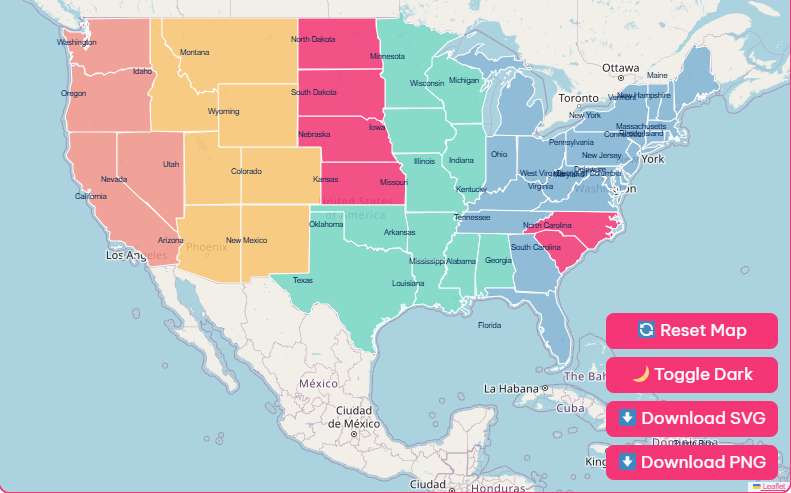
The United States and its territories observe nine official time zones.
Four of these cover the contiguous (or lower 48) states, while Alaska and Hawaii have their own. Three additional zones are used by unincorporated US territories.
Here’s a quick overview of the main US time zones and their standard UTC offsets:
| Time Zone | Abbreviation | Standard UTC Offset |
| Eastern Time | ET | UTC-5 |
| Central Time | CT | UTC-6 |
| Mountain Time | MT | UTC-7 |
| Pacific Time | PT | UTC-8 |
| Alaska Time | AKT | UTC-9 |
| Hawaii-Aleutian Time | HST | UTC-10 |
It’s important to note these are the standard offsets.
Most (but not all) locations observe Daylight Saving Time (DST), which shifts the clock forward one hour during the spring and summer months.
During DST, the UTC offset for these zones changes (e.g., Eastern Time becomes UTC-4).
Detailed Breakdown of Each Time Zone
Let’s explore each time zone, including the states and major cities within them and how they are affected by Daylight Saving Time.
Eastern Time Zone (ET)
The Eastern Time Zone is the most populous time zone in the United States.
During standard time, it is known as Eastern Standard Time (EST), and during Daylight Saving Time, it becomes Eastern Daylight Time (EDT).
States Fully in ET
Connecticut, Delaware, Georgia, Maine, Maryland, Massachusetts, New Hampshire, New Jersey, New York, North Carolina, Ohio, Pennsylvania,
Rhode Island, South Carolina, Vermont, Virginia, West Virginia. It also includes Washington, D.C.
States Partially in ET
Florida, Indiana, Kentucky, Michigan, and Tennessee share ET with the Central Time Zone.
Major Cities
New York City, Philadelphia, Miami, Atlanta, Boston, Washington D.C., Detroit.
Daylight Saving Time
Observed. Clocks spring forward to EDT (UTC-4) from the second Sunday in March to the first Sunday in November.
Central Time Zone (CT)
The Central Time Zone covers a large portion of the central United States. It is referred to as Central Standard Time (CST) and Central Daylight Time (CDT).
States Fully in CT
Alabama, Arkansas, Illinois, Iowa, Louisiana, Minnesota, Mississippi, Missouri, Oklahoma, Wisconsin.
States Partially in CT
Florida, Indiana, Kansas, Kentucky, Michigan, Nebraska, North Dakota, South Dakota, Tennessee, and Texas are split between CT and other time zones.
Major Cities
Chicago, Houston, Dallas, Minneapolis, New Orleans.
Daylight Saving Time
Observed. Clocks move forward to CDT (UTC-5) during DST months.
Mountain Time Zone (MT)
The Mountain Time Zone gets its name from the Rocky Mountains, which are located almost entirely within this zone.
It is known as Mountain Standard Time (MST) and Mountain Daylight Time (MDT).
States Fully in MT
Colorado, Montana, New Mexico, Utah, Wyoming.
States Partially in MT
Arizona, Idaho, Kansas, Nebraska, Nevada, North Dakota, Oregon, South Dakota, Texas.
Major Cities
Denver, Salt Lake City, Phoenix, Boise, El Paso.
Daylight Saving Time
Observed in most areas, switching to MDT (UTC-6).
The major exception is Arizona, which (with the exception of the Navajo Nation) does not observe DST and remains on MST year-round.
Pacific Time Zone (PT)
The Pacific Time Zone covers the West Coast of the United States. It’s known as Pacific Standard Time (PST) and Pacific Daylight Time (PDT).
States Fully in PT
California, Washington.
States Partially in PT
Oregon, Nevada, Idaho.
Major Cities
Los Angeles, San Diego, San Francisco, Seattle, Las Vegas, Portland.
Daylight Saving Time
Observed. Clocks shift to PDT (UTC-7) for DST.
Alaska Time Zone (AKT)
As its name suggests, the Alaska Time Zone covers most of the state of Alaska.
The standard time is Alaska Standard Time (AKST), and the daylight time is Alaska Daylight Time (AKDT).
Regions
Encompasses almost all of Alaska.
Daylight Saving Time
Observed. During DST, the time becomes AKDT (UTC-8). A small portion of the Aleutian Islands uses the Hawaii-Aleutian Time Zone.
Hawaii-Aleutian Time Zone (HST)
This zone includes Hawaii and the western part of the Aleutian Islands. Its standard time is Hawaii Standard Time (HST).
Regions
The state of Hawaii and the Aleutian Islands west of 169°30′ W longitude.
Daylight Saving Time
Not observed in Hawaii. The state remains on HST (UTC-10) all year. The Aleutian Islands portion, however, does observe DST.
Other US Time Zones
Beyond the 50 states, several US territories have their own time zones:
Atlantic Time Zone (AST)
Used in Puerto Rico and the U.S. Virgin Islands. It is UTC-4 and does not observe DST.
Samoa Standard Time (SST)
Used in American Samoa. It is UTC-11 and does not observe DST.
Chamorro Standard Time (ChST)
Used in Guam and the Northern Mariana Islands. It is UTC+10 and does not observe DST.
Daylight Saving Time (DST) in the USA
Daylight Saving Time is the practice of setting clocks forward one hour from standard time during the warmer months so that darkness falls at a later clock time.
The idea is to make better use of natural daylight.
In the United States, DST begins on the second Sunday in March and ends on the first Sunday in November. On these dates, clocks are adjusted at 2:00 AM local time.
However, not all states and territories observe DST.
- Hawaii and Arizona (except for the Navajo Nation) do not observe DST.
- The territories of American Samoa, Guam, the Northern Mariana Islands, Puerto Rico, and the U.S. Virgin Islands also do not observe DST.
This can create confusion. For instance, during the summer, Arizona has the same time as California (Pacific Time), but during the winter, it aligns with Colorado (Mountain Time).
Tips for Navigating Time Zones
Managing time differences can be tricky, but with a few strategies, you can avoid confusion.
Always Specify the Time Zone
When scheduling a meeting or event, don’t just say “9:00 AM.” Instead, specify the time zone, like “9:00 AM Eastern Time” or “9:00 AM ET.” This simple habit eliminates ambiguity.
Use Online Time Converters
You can enter multiple locations and instantly see the time difference. Many calendar apps, like Google Calendar, also have built-in time zone conversion features.
Double Check DST
Be mindful of when DST begins and ends. A meeting scheduled in October might be affected by the fall-back change.
Always confirm if the locations involved observe DST.
Keep a Visual Reference
Use a time zone map or a world clock on your phone or computer. Having a visual aid can make it much easier to quickly reference the time in different parts of the country.
Master the Clock
Ready to put your knowledge to the test? Explore our interactive map to see the current time across the United States and get comfortable with the nation’s clockwork.